
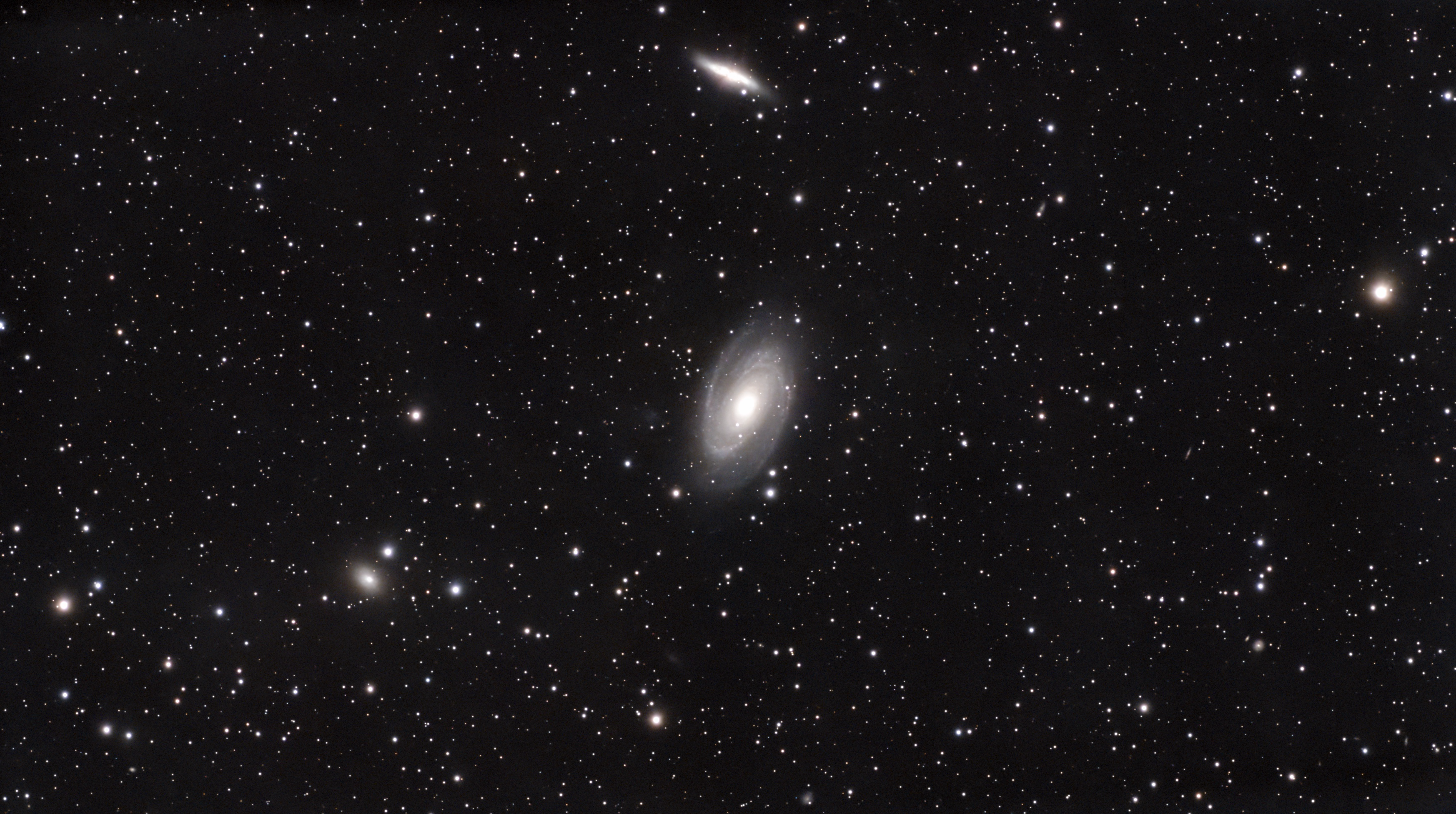
I expected this DWARF 3 M81 project to improve with more integration time. What I did not expect was for it to become one of the clearest lessons yet in how exposure length shapes a final image on the DWARF 3.
As the stack deepened, something unexpected appeared in the field: a faint smudge near the edge of the frame. It turned out to be UGC 5210, a background galaxy around magnitude 14.88. Catching something that faint from Bortle 6 skies, with the moon near full, felt remarkable. But the bigger surprise was what the data itself was telling me about how I had been capturing.

This image was built from two sessions totaling 15 hours and 14 minutes. The result went deeper than expected, and it came with a clear lesson: longer exposures produced a noticeably smoother and more usable background than the shorter runs tried earlier.
Quick Answer: What Did This M81 Project Teach Me?
For galaxy imaging with the DWARF 3, longer exposures can produce a smoother and more usable background than very short exposures, even when total integration time is high.
In earlier M81 sessions, short exposures produced visible background banding and patterning after stacking and stretching. With 60-second subs, the signal per frame was stronger, the number of read cycles was much lower for the same total integration, and the final background came out noticeably smoother.
Capture Details
- Target: M81 and M82
- Field notes: M81 centered, M82 above, NGC 3077 also likely in the field
- Telescope: DWARF 3
- Total integration: 15h 14m over 2 sessions
- Exposure: 60 seconds
- Gain: 50
- Filter: Astro
- Sky: Bortle 6, moon near full
- Processing: DWARF Stellar Studio mega stack, auto edit, finishing in Snapseed
Why I Switched from Short Exposures to 60-Second Subs on M81
Before this result, I had already spent time on M81 using shorter exposures, around 10 to 15 seconds. In one earlier run, I pushed all the way to 999 captures. The total integration sounded impressive, but once stacked and stretched, the background showed visible banding and patterning. The image had signal, but the background never became smooth enough to stretch confidently.
With galaxies, especially under light pollution and moonlight, it is not only total integration time that matters. Signal per sub matters too. A short exposure records less target signal per frame, and hundreds of frames means hundreds of sensor readouts. That repeated readout adds up. Once you stretch the image, low-level background structure and fixed-pattern noise become very hard to ignore.

Why the Longer Exposures Helped
Stronger Signal Per Frame
Each 60-second exposure captured more useful galaxy light than a 10-second or 15-second sub. That made the stacked data more resilient when pushed in processing.
Fewer Sensor Read Cycles
Shorter exposures require many more frames for the same total time, meaning more cumulative read noise and more opportunity for fixed-pattern structure to survive into the final image.
Better Background Behavior
This was the biggest real-world difference. The 60-second data gave a more natural background to work with. Galaxy imaging often lives or dies in the faint outer structure and in the sky behind it.
A Note on Gain
For this project I stayed at gain 50, which balanced sensitivity with a clean result. With bright sky and moonlight in play, a clean background was just as important as raw signal accumulation, and gain 50 paired well with 60-second subs.
The Moment the Field Went Deeper Than Expected
M81 and M82 are the obvious subjects of the frame. But what made this result memorable was what appeared beyond them. As the stack deepened, faint background galaxies began to emerge. The most notable was UGC 5210, sitting near the edge of the frame at around magnitude 14.88.

What This Means for DWARF 3 Galaxy Imaging
The takeaway is straightforward: do not think only in terms of total hours. Think about exposure efficiency and background quality too.
Short exposures are not always wrong, but for this target and these conditions, they gave a less stable background. The 60-second data was clearly better, and the improvement showed up most where it matters: in the faint structure and in how the background behaved under stretching.
Processing cannot fully rescue a weak capture strategy. A smoother background starts at capture, not in software.
What Comes Next
This project is not finished. I plan to return to M81 for two more sessions of around 7 or 8 hours each, then combine everything into an even larger mega stack. The goals are straightforward: smoother background, stronger faint outer detail, and a deeper look at what else is hiding in this field.
UGC 5210 already proved there is more to find.
FAQ
Why were 60-second exposures better than 10-second or 15-second exposures on M81?
60-second subs recorded stronger signal per frame and required fewer total sensor readouts, which helped reduce visible background banding after stacking and stretching.
What settings were used for the DWARF 3 M81 image?
Astro filter, 60-second exposures, gain 50, total integration 15 hours and 14 minutes over two sessions under Bortle 6 skies with the moon near full.
Can the DWARF 3 capture faint galaxies like UGC 5210?
Yes. With sufficient integration time and careful settings, the DWARF 3 can reveal faint background galaxies. UGC 5210 at approximately magnitude 14.88 was detected in a 15-hour mega stack from Bortle 6 skies with the moon near full.
Can you image M81 under Bortle 6 skies with the moon up?
Yes, but it is demanding. Long integration time, efficient exposure strategy using 60-second subs, and careful processing become significantly more important under those conditions.


Leave a Reply