
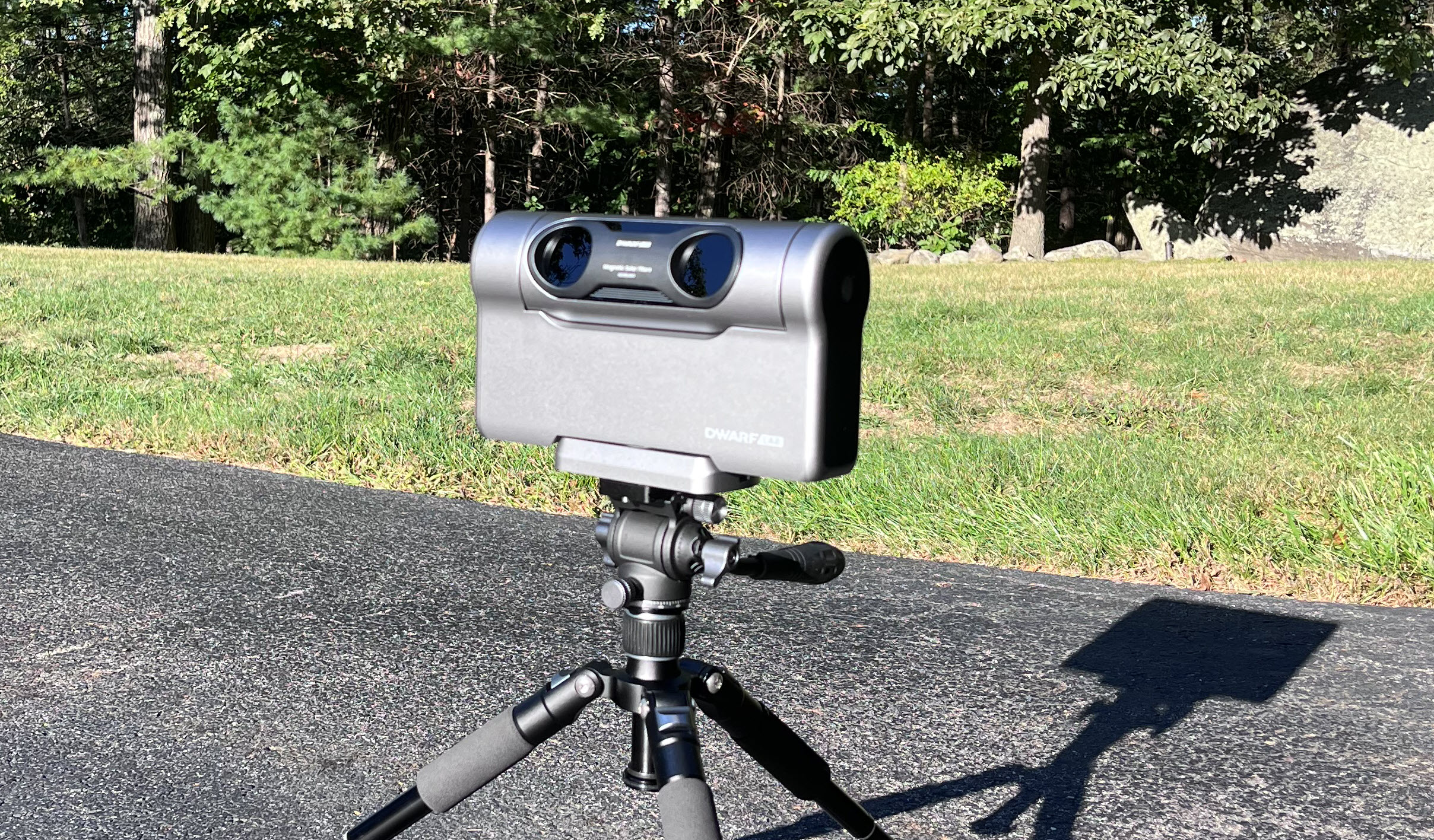
The DWARF 3 is a compact, uncooled CMOS smart telescope designed for automated astrophotography. While it simplifies the process of capturing the night sky, its performance is governed by the fundamental laws of physics, specifically aperture size, sensor thermal noise, and signal-to-noise ratio (SNR).

Quick Summary: DWARF 3 Capabilities
- Aperture: 35mm (requires long integration times for deep-sky objects).
- Sensor: Sony IMX678 (uncooled; requires dark frames to manage thermal noise).
- Mount: Motorized Alt-Az/EQ tracking (optimized for 30–60s sub-exposures).
- Output: RAW FITS files for professional post-processing.
DWARF 3 Technical Specifications & Hardware Limits
At its core, the DWARF 3 is a small-aperture refracting telescope paired with an uncooled CMOS imaging sensor, mounted on a motorized tracking platform. Each of these elements imposes physical limits that automation cannot bypass:
- Aperture: Determines photon collection speed. A 35mm aperture gathers light at a fixed rate; it is not a flaw, but a physical constraint.
- Sensor: Converts light into electrical signals. Because it is uncooled, it generates “dark current” (heat-induced noise).
- Mount: Compensates for Earth’s rotation. While highly accurate, it is designed for stacking many short exposures rather than single hour-long frames.
Understanding Aperture in Smart Telescopes
Aperture controls signal acquisition speed. Larger telescopes collect more photons per second, whereas the DWARF 3 requires more time to collect the same amount of data.
The system compensates for its size by encouraging long total integration times through stacking. This is why a single 15-second exposure may look unimpressive; the signal is buried. Only after hours of data are combined does the faint structure of a nebula or galaxy emerge.
Tracking Accuracy and Exposure Limits
The DWARF 3 can track accurately enough to support sub-exposures in the range of 30 to 60 seconds under ideal conditions.
- Below 30s: Read noise from the sensor can dominate the image.
- Above 60s: Mechanical tracking error and thermal drift may begin to blur stars.
This defines the system’s practical operating window. Astrophotography with this device is built around the “lucky imaging” philosophy: collecting hundreds of moderate-length exposures to create one deep-master file.
Managing Sensor Noise and Heat
Because the sensor is uncooled, its temperature fluctuates during a session. As the sensor warms up, dark current increases, adding “fog” to your data. Every image contains a mixture of light from the sky and electronic noise.
This is why dark frames are not optional for the DWARF 3. They are the only way to measure the sensor’s internal noise and subtract it from your final image. Without proper calibration, you aren’t seeing the sky; you’re seeing the limitations of the electronics.
Why the DWARF 3 is an Honest Teaching Tool
One of the DWARF 3’s greatest strengths is its transparency. It does not hide physics behind aggressive AI-generated overlays or “fake” sharpening.
- Thin data looks thin.
- Noisy data looks noisy.
- Poor calibration reveals itself immediately.
In this sense, it is a professional-entry teaching instrument. It provides immediate feedback, accelerating the user’s understanding of how light collection actually works.
Final Verdict: Is the DWARF 3 for Beginners?
Yes, the DWARF 3 is an exceptional tool for beginners, provided it is approached as a scientific instrument rather than a point-and-shoot camera. If you expect effortless results, you may be disappointed. If you approach it as a compact system that obeys the same physical laws as a professional observatory, your progress will be steady and predictable.
What’s Next in This Series?
Now that we understand the hardware constraints, we need to address the “emotional shock” of the first raw image. In my next article, I explain Why Early Images Disappoint and why that initial “gray smudge” is actually a sign of success.
Clear Skies!
FAQ
Is the DWARF 3 a real astrophotography tool or a toy?
he DWARF 3 is a functional astrophotography instrument with a 35mm aperture, Sony IMX678 sensor, and motorized tracking. It automates mechanical setup but operates under the same physical constraints as any telescope. Results depend on integration time, calibration, and correct settings.
What sensor does the DWARF 3 use?
The DWARF 3 uses a Sony IMX678 Starvis 2 sensor at 2 micrometers per pixel and 8.3 megapixels. It is uncooled, meaning thermal noise increases with ambient temperature and session length.
Why do dark frames matter on the DWARF 3?
Dark frames measure the sensor’s internal electronic noise pattern. Without matched dark frames, stacking reinforces sensor artifacts rather than suppressing them, resulting in muddy backgrounds regardless of integration time.
What is the maximum useful exposure length on the DWARF 3?
In Guided EQ mode, 60 seconds is the supported maximum. In Alt-Az mode, 15 seconds keeps star shapes round. Below 30 seconds in either mode, read noise can dominate faint signal.

Leave a Reply