
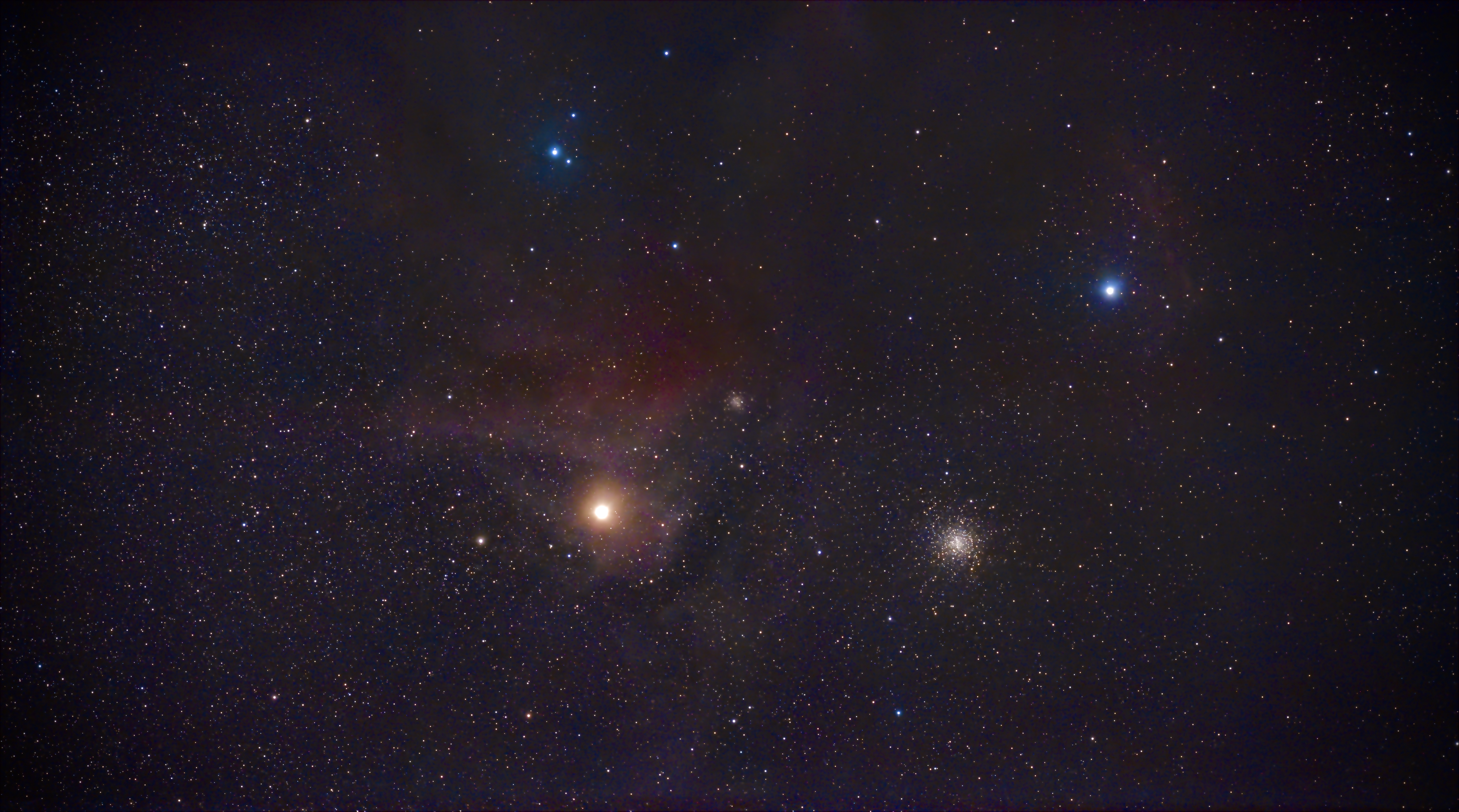
Antares and Rho Ophiuchi never gets high from a New England backyard. At roughly 42 degrees north latitude, the star tops out somewhere around 20 to 30 degrees above the southern horizon on its best night, and that assumes a tree line that cooperates. Most of my targets this year have been circumpolar or at least willing to climb past 40 degrees before I start a session. Antares does neither. I pointed the DWARF 3 at it anyway, twice, on July 13 and again on August 6, and stitched the result into a mosaic because a single frame wasn’t going to do the color in that field justice.
The field itself is the reason to bother. Antares is a red supergiant close enough and bright enough that its light bleeds gold and orange dust across the frame. A few degrees away sits M4, the globular cluster that is, depending on which measurement you trust, either the closest or among the closest globular clusters to Earth. And woven through the dust is IC 4605, a reflection nebula that the DWARF app’s plate-solve tagged directly onto the July 13 export. Three objects, three wildly different distances, all sharing one eyepiece view. That’s the pitch for shooting this field even knowing the altitude is against you.
Why a mosaic instead of a single frame
A single DWARF 3 frame at native focal length covers the core of the region: Antares, M4, and the immediate dust halo. It does not comfortably fit the wider gold and blue structure that makes this part of the sky worth photographing, the same structure that shows up in wide-field shots of the Rho Ophiuchi complex just to the north. Cropping in loses the color gradient. The choice was between a wide single shot with the dust barely registering, or two overlapping panels stitched afterward. I went with the mosaic.
That decision came with a cost I underestimated going in. This mosaic ended up needing two separate nights instead of one clean run, because the first session did not leave me with a second panel I was happy with. Antares sitting at 20 degrees altitude means the shooting window each night is short and the air path is long, which is exactly the condition that produces the seeing problems a mosaic cannot hide as easily as a single frame can.

Session one: July 13, 46 minutes
The first panel ran the night of July 13 into the early hours of the 14th. Thirty-second sub-exposures, gain 60, Astro filter, EQ mode. I chose Astro over Duo-Band deliberately here: Antares and its surrounding dust are broadband targets, reflecting and scattering starlight rather than emitting in the narrow hydrogen-alpha and OIII bands the Duo-Band filter isolates. A Duo-Band pass would have thrown away most of the color this field actually has to offer.
Forty-six minutes of usable integration came out of that first night, which by the standards of some sessions on this site is a short run. For a target sitting this low, though, 46 minutes is close to what the geometry allows before the object either drops behind the tree line or the air mass gets bad enough that the frames aren’t worth keeping. The DWARF app’s own log on this stack, tagged automatically to the nearest catalog match, reads IC 4605 at 1 hour 18 minutes for that export. I’m noting the discrepancy rather than picking one number and pretending there isn’t one: my own count from the session was 46 minutes of frames I considered usable, the app’s internal accounting on the merged export shows more. Both numbers are on record here so a future re-check can settle which one reflects what actually stacked in.
Session two: August 6, roughly 20 usable minutes
The second panel, meant to extend the mosaic and add depth, ran into weather almost immediately. Clouds moved through for most of the window, and out of what should have been a comparable session length, only about 20 minutes of frames were clean enough to keep. The rest went into the DWARF app’s rejection pile or got manually pulled during review.
This is the least satisfying kind of session to write up, because there’s no clean narrative arc to it. I wanted a second panel with integration time close to the first one, and instead I got roughly a quarter of what I was hoping for. What went into the final mosaic from that night is thin, and it shows in the noise floor on that side of the frame compared to the July 13 panel.

How mosaic mode actually works on the DWARF 3
DWARF 3’s mosaic mode is set up in the app’s Atlas view, where a mosaic icon lets you choose the overall frame size you want to cover rather than positioning each panel by hand. The app works out the panel layout and overlap from that selection, then slews between panels and captures them in sequence as one run. It builds a rough on-device preview when the run finishes, and the real stitched image gets built afterward in Stellar Studio.
What I did differently here was run that whole process twice, on two separate nights, because the July 13 session did not leave me with a second panel I was happy with. That is a choice to redo a panel later, not how the mosaic tool itself is designed to work. What matters when you split a mosaic across nights like this is matching transparency and exposure settings so the panels do not visibly disagree in brightness or color once merged. Thirty-second subs at gain 60, EQ mode, on both nights kept that consistent here, even though the total integration split unevenly.
Blending happens either on-device through the app’s stitch function or afterward in an external editor. For this project the panels were combined and finished in Snapseed on the phone, which is consistent with how most of the processing on this site gets done, but it’s worth knowing that a seam is the thing to watch for. If one panel has meaningfully less signal than the other, as happened here with the cloud-shortened second session, the seam shows up as a visible change in noise texture even after color and brightness are matched. That’s present in this result if you look at it at full resolution. Persistence and a full clear-sky session on the second panel would fix it. I plan to go back for that when Scorpius is back in a usable position next season.
What the field actually contains
Antares itself is a red supergiant roughly 550 light-years away, spectral type M1.5, with a radius on the order of 680 times the Sun’s. It’s the sixteenth-brightest star in the sky and one of the few stars large enough that its angular diameter has been measured directly rather than inferred. The gold and brown dust immediately around it in this image is illuminated and reddened starlight, not a separate cataloged object so much as the general dust field of the Antares molecular cloud, part of the same star-forming complex that includes the better-known Rho Ophiuchi cloud a few degrees north.
M4, the globular cluster visible as a resolved ball of stars in the lower right of the frame, is one of the closest globular clusters to Earth, at a distance on the order of 6,000 to 7,200 light-years depending on the measurement method. That puts it more than ten times farther away than Antares despite sitting in the same field of view: a line-of-sight pairing, not a physical one. M4 has an apparent magnitude around 5.6, technically within naked-eye range under a dark sky, though at Bortle 6 it needs the telescope.
IC 4605, the reflection nebula the app’s plate-solver identified in the July 13 export, sits within the broader Rho Ophiuchi cloud complex, a star-forming region generally placed at several hundred light-years. Reflection nebulae like this one don’t glow on their own; they scatter the light of nearby hot stars off dust grains, which is why the color reads blue rather than the red of an emission region. It’s a smaller, quieter feature compared to Antares and M4, but it’s the reason a broadband Astro filter was the right call over Duo-Band for this session.


What worked, what didn’t, and what’s next
The color came through, which was the entire reason to shoot this field as a mosaic instead of settling for a tighter single frame. Antares reads gold and orange against genuinely blue reflection dust, and M4 resolves into individual stars rather than a fuzzy blob, which at 46 minutes of Astro-filter data on a target this low is a reasonable outcome.
What didn’t work was the second session. Twenty minutes against clouds is not enough to match the first panel’s depth, and the seam between the two tiles is visible if you go looking for it. That’s not a processing failure, it’s a data problem, and the fix is more clear-sky time on that second panel rather than a different approach in Snapseed.
This is a target I’ll return to. Low-altitude, short-window objects like this reward exactly the kind of patience that a single bad-weather night takes away. Next pass, I want both panels shot the same way this one’s first panel was: full duration, no interruption, and enough margin in the schedule to wait out a cloudy night rather than accept whatever twenty minutes it gives me.
Clear skies!
Why shoot Antares as a mosaic instead of a single frame?
A single DWARF 3 frame captures Antares and the M4 globular cluster but crops out the wider gold and blue dust structure that extends across the field. A two-panel mosaic keeps that structure in frame. This one ended up split across two separate nights because the first session did not leave a second panel worth keeping, and the mismatched conditions between those nights show up as a visible seam.
What filter works best for the Antares region on the DWARF 3?
Astro filter, not Duo-Band. Antares and its surrounding dust are broadband reflection and starlight-scattering targets, not narrowband emission sources. A Duo-Band filter isolates hydrogen-alpha and OIII, which this field doesn’t produce much of, so it would throw away most of the color.
How do you plan a mosaic in the DWARF app?
Set the overall frame size you want to cover in the app’s Atlas view rather than positioning individual panels by hand. The app works out the panel layout and overlap from that selection, then captures the panels in sequence as one automatic run, in EQ mode. Redoing or extending a mosaic on a separate night, as happened with this Antares session, is a deliberate choice to reshoot a panel, not the normal mosaic workflow.
Are Antares, M4, and IC 4605 physically related?
No. They share a field of view but not a distance. Antares is about 550 light-years away, IC 4605 sits within the Rho Ophiuchi star-forming complex at a few hundred light-years, and M4 is roughly 6,000 to 7,200 light-years out, more than ten times farther than Antares. It’s a line-of-sight grouping, not a physical association.
Why is Antares such a difficult target from New England?
At around 42 degrees north latitude, Antares tops out at roughly 20 to 22 degrees above the southern horizon. That’s a short shooting window each night, a long path through the atmosphere for the light to travel, and a hard cutoff once the star drops behind the tree line. It’s one of the lowest-altitude targets imaged on this site.

Leave a Reply