
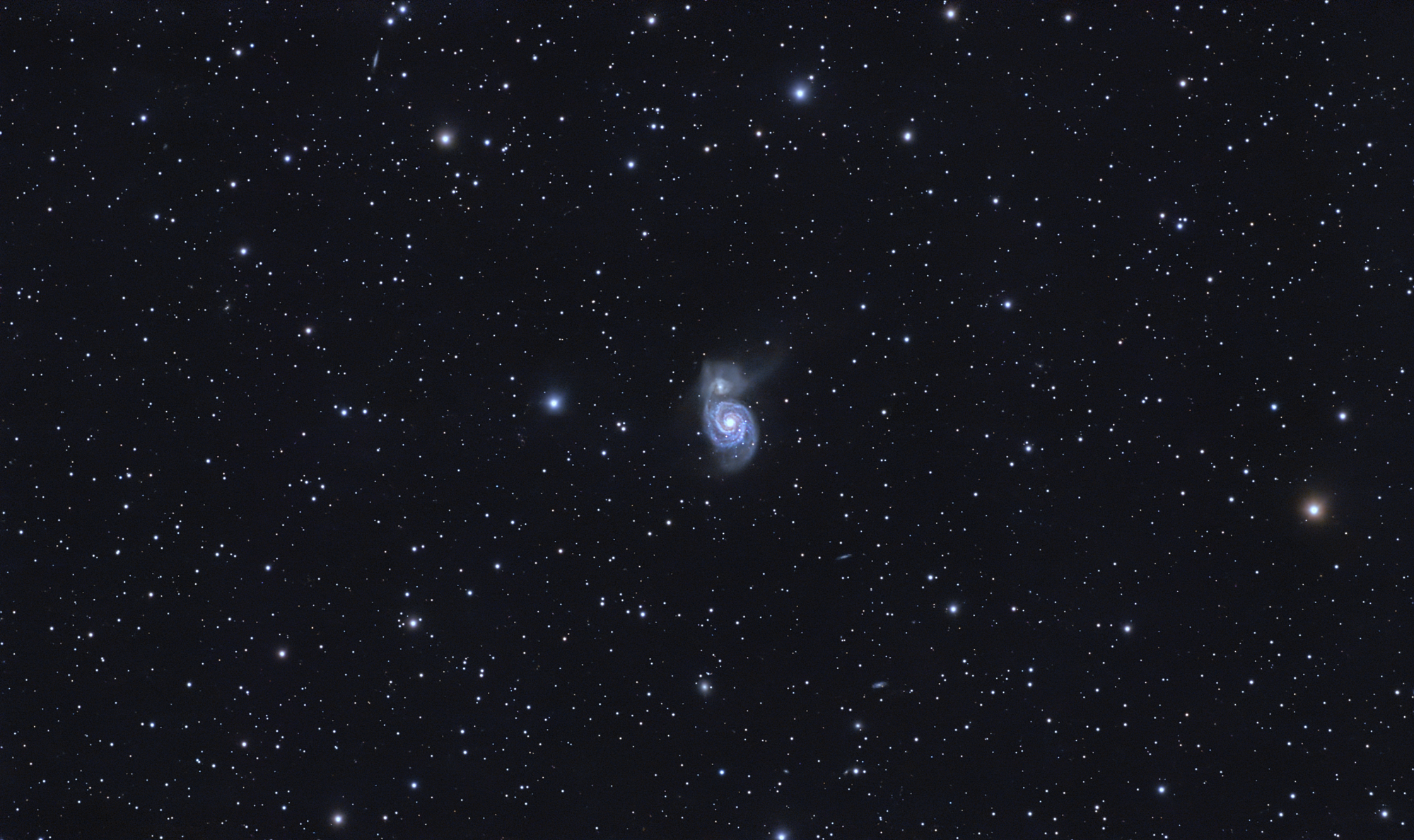
The first time I pointed the DWARF 3 at M51 was August 14th last year. Eight and a half minutes, Alt-Az mode, gain 60, Astro filter. Both galaxies showed up and the arms were there in rough form, but nothing resolved. I noted it and came back in April 2026.
The months between went into learning the instrument properly. EQ mode, dark library generation, what sensor temperature and gain actually contribute to a stacked result. By April, that groundwork was in place.
April 12 was the first real run on M51: 429 subs, 392 in the stack, 6 hours and 32 minutes of usable data. The data was solid. I went back in June anyway.

M51 is 27 million light-years out in Canes Venatici, just off the handle of the Big Dipper. It’s a face-on grand-design spiral, so the full arm structure presents to the camera rather than being foreshortened by inclination. NGC 5195, the smaller companion at the tip of the northern arm, isn’t just sitting there. It passed through M51’s disk. Simulations put the most recent crossing somewhere between 50 and 100 million years ago, with a prior pass 500 to 600 million years before that. The arms owe their definition to that collision history. Lord Rosse first resolved the spiral in 1845 using a 72-inch reflector he built in Ireland. The DWARF 3 is covering the same ground, 180 years later and without the country estate.

June added two hours of acquisition, one hour and forty minutes in the stack. Conditions were about as good as the backyard gets: clean polar alignment, sensor temperature stable the whole run, dark frames matched. When the background is that clean from a single session, you use it. Three sessions, 8 hours and 14 minutes.
That depth went into the tidal bridge. The arm connecting M51 to NGC 5195 needs real integration before it stops reading as noise, and 8 hours from Bortle 6 gets past that threshold. The DWARF 3 frames both galaxies without crowding, which at this apparent size isn’t guaranteed.
I processed the stack in Snapseed after Stellar Studio stacking. The background came in flat, which meant I wasn’t fighting it. I didn’t need to push hard enough to damage the outer disk structure.

M51 was also the start of a longer summer project: an attempt on OU4, the Squid Nebula, inside SH2-129, the Flying Bat Nebula. The Flying Bat is showing at 5 hours of Duo-Band integration. The Squid isn’t yet. At 5 hours, that’s expected. More on that separately.
Clear skies,
AK
How much integration time does M51 need on the DWARF 3?
Eight hours produces a well-defined result from Bortle 6. The tidal bridge between M51 and NGC 5195 is visible and defined at that depth. The April session at 6h 32m was usable on its own, but stacking the June session on top tightened the outer structure noticeably. Galaxy targets on this site generally run between 6 and 15 hours depending on surface brightness.
What filter works best for M51 on the DWARF 3?
The Astro filter is the right call for galaxies. The Duo-Band filter isolates H-alpha and OIII, which is the correct choice for emission nebulae but cuts most of the broadband signal that galaxy detail lives in. Every dedicated galaxy session on this site (M81, M106, M101, M63, and now M51) has used the Astro filter at gain 50 with 60-second subs in EQ mode.
What is the tidal bridge in M51?
The tidal bridge is the arm of M51 that extends northward and connects visually to NGC 5195. It formed because NGC 5195 passed through M51’s disk. Simulations suggest the most recent crossing happened somewhere between 50 and 100 million years ago. The gravitational disruption from that interaction is what gives M51 its unusually well-defined grand-design spiral structure.
Does a mega-stack across multiple nights improve DWARF 3 galaxy results?
Yes, provided the sensor temperature and dark frames are matched across sessions. The M51 result came from three sessions: a first attempt of 8 minutes and 30 seconds in August 2025, an April session with 6 hours and 32 minutes in the stack, and a June session that added another hour and forty minutes. The June data had particularly stable sensor temperature and well-matched darks, which contributed a clean background to the combined stack. The result was noticeably flatter than any single session would have produced on its own.
Why is M51 a good target for the DWARF 3?
M51 is a face-on spiral at roughly 27 million light-years, which means the full arm structure is visible rather than foreshortened. The apparent size of the M51 and NGC 5195 pair fits the DWARF 3’s field without requiring a mosaic. The tidal bridge between the two galaxies responds to integration depth rather than requiring unusual processing technique.
Leave a Reply