

Our own galaxy is the one target I could never actually see. From my Bortle 6 backyard the Milky Way is barely a rumor, a faint brightening low over Cygnus on the best nights and nothing at all on the rest. I had wanted to shoot it for years and kept putting it off, because there is something deflating about aiming a telescope at a thing you cannot even find by eye. This time I found it in four hours of stacked light: a real DWARF 3 Milky Way frame with the star clouds and dark lanes through Cygnus finally showing.

Framing our own galaxy
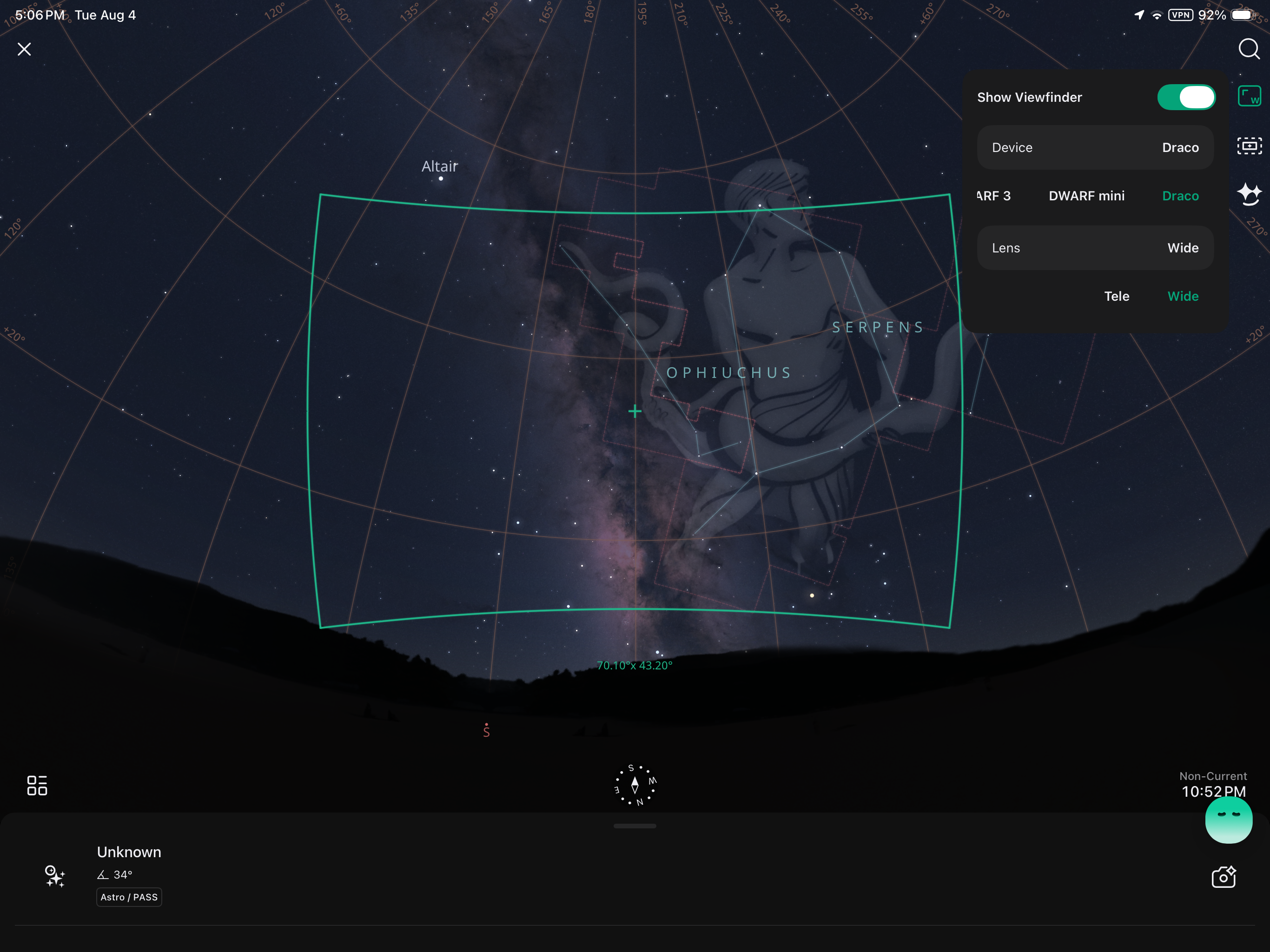
The Milky Way is not a point you center on. It is a band, and the only real decision is which stretch of it to put on the sensor. I worked that out in the atlas view in the DWARF app, which lays the wide-angle field over the sky so you can see what will land in frame before committing to anything. I set it across Cygnus, on Sadr at the center of the Northern Cross, with the field reaching down toward Albireo and swallowing the dark rifts that cut through the band. The wide-angle lens is what makes any of this possible. At roughly 45 by 26 degrees it takes in most of Cygnus at once.

What is actually in the frame
Look toward Cygnus and you are looking straight down the length of our own spiral arm, the Orion Arm, rather than across it. That is why the stars pile up here. They stack along the line of sight and smear into the glow we call the Cygnus Star Cloud, the bright patch filling the top half of my frame.
Sadr, the star I framed on, is more than a bright point. It sits inside a wide field of hydrogen, the Gamma Cygni nebula, IC 1318, which the Astro filter and four hours of integration pull out as a faint red wash around the center. Then there is the dark stuff. The Great Rift is a lane of interstellar dust thick enough to hide the stars behind it, and it splits the band lengthwise and gives the picture most of its shape. Those black channels are not gaps in the sky. They are dust clouds sitting between us and the starlight, the same clouds where new stars get made. Near the bottom edge is Albireo, the double that marks the swan’s head.
Why Bortle 6 makes the Milky Way hard
From a dark site the Milky Way is unmissable, a bright arch once your eyes adapt. From my street the sky glow eats most of it before it ever reaches me.
Overhead every clear summer night, and I still cannot pick it out.
The camera gets around this by doing what an eye cannot. Your eye takes one glance and discards it. The DWARF 3 takes hundreds of short frames and adds them up, so faint signal that never registers in a single look accumulates while the random noise averages away. Four hours of stacked light from a mediocre sky beats one good look from a dark one, at least for something this faint.
The capture
Thirty second subs, gain 60, Astro filter, EQ mode, 4 hours 18 minutes from Bortle 6. Setup was quick, which is just how the DWARF 3 goes. The only extra step was darks. The wide-angle lens needs its own set, and the darks I keep on file were all shot through the telephoto lens, so I had to capture a fresh batch for the wide field before I could start.
That 4 hours 18 minutes comes out to 516 subs at 30 seconds. Shorter than the 60 second subs I run on galaxies, but on a wide field that is the right length. Nothing small to trail, no need to frame precisely across 45 degrees of sky, and the shorter exposure keeps the bright Cygnus star cloud from clipping while the total time still does the faint work.

From stack to final
The raw stack comes out flat. The band is there but it sits right on top of the sky background, which is what a wide field over a bright suburban horizon gives you. The lighter version above is close to where the data lands before I touch it. The frame at the top of the post is that same stack pushed harder in Snapseed, contrast and structure raised until the dust lanes separate from the star clouds and the Cygnus glow comes forward.
A wide field is less forgiving of heavy processing than a tight crop. Lean on the contrast too hard and the uneven background across the frame goes blotchy, and the dark lanes start reading as edits rather than dust. I stopped once the structure held up without the sky turning patchy. It is a little overcooked to make the band pop, and for this one I am fine with that.
The other galaxies
Almost everything else I aim the DWARF 3 at is the reverse of this. Small, far off, other galaxies seen from the outside across millions of light-years. The Fireworks Galaxy (NGC 6946) is practically next door in the sky, just off Cygnus, dimmed by the same dust you can see cutting through the band in this frame. The Whirlpool (M51) and the edge-on Needle Galaxy (NGC 4565) sit at the tight end of the range, where the wide field gives way to the postage-stamp crop.

This one was the odd target out. The subject was not somewhere out across the void. It was the thing I was already sitting inside, and I still needed four hours and a stacked frame to see it.
Clear skies.
Frequently Asked Questions
Can the DWARF 3 photograph the Milky Way?
Yes, with the wide-angle lens. This frame is 4 hours 18 minutes of 30 second subs at gain 60 across Cygnus from a Bortle 6 sky.
How do you frame the Milky Way with the DWARF 3?
Use the atlas view in the DWARF app. It overlays the wide-angle field on the sky so you can place the band before capturing. This session was framed across Cygnus on Sadr, at the center of the Northern Cross.
Do you need the wide-angle lens to shoot the Milky Way with the DWARF 3?
For the band itself, yes. The Milky Way is tens of degrees wide, so it needs the wide-angle lens, which takes in roughly 45 by 26 degrees. The standard lens is framed for small deep sky targets and cannot fit the band.
Can you photograph the Milky Way from a light-polluted Bortle 6 sky?
Yes. The band is nearly invisible to the eye from Bortle 6, but stacking hundreds of short exposures builds up faint signal the eye never registers. This image is 4 hours 18 minutes of stacked light from a suburban backyard.
Why capture new dark frames for the wide-angle lens?
The wide-angle lens needs its own dark frames. Darks shot through the standard lens do not transfer to it, so capture a fresh set before a wide-field session.
Leave a Reply