

M51 was the first target with the Dwarf 3. August 2025, Alt-Az mode, 8 minutes and 30 seconds of 15-second subs on a galaxy low in the summer sky. The telescope was a few weeks old. I stopped when the image looked like what I thought a galaxy should look like. M51 and NGC 5195 were both there, two smudges with a faint hint of connection, and that was enough to confirm the thing worked.
Twelve months later, the M51 frame I work from is a mega-stack totaling 8h 14m across three separate nights, all in EQ mode with matched darks. The tidal bridge between M51 and NGC 5195 pulls cleanly out of the noise in that stack. The hardware was unchanged across both results. What changed is everything else.


The recipe that produced most of what is on this site: 60s subs at gain 50 for broadband galaxy targets, 60s at gain 90 with the Duo-Band filter for emission nebulae, EQ mode from the start of each session. Dark frames come from a library built across four seasons and reused consistently as long as temperature stays within a few degrees of a stored batch. Processing starts with the auto-adjust in Stellar Studio and a PNG export to Snapseed for final edits. Fast enough to run the night after a session and not a chore.
Twenty-seven deep-sky targets, 157 hours and 23 minutes of stacked integration, twelve months of clear nights from the same Bortle 6 backyard. This is every session that has a published post on this site, in the order it happened.
At a Glance
Three sessions here are not deep sky: the Star Trail Mode test and two solar sessions. All three are included because they are part of the record.
- Helix Nebula NGC 7293 · Nov 19, 2025 · 1h 46m
- Heart Nebula IC 1805 · Nov 22, 2025 · 3h 52m
- Horsehead and Flame Nebula · Nov 23, 2025 · 2h 54m
- White-light Solar · Dec 3, 2025 (solar, not deep sky)
- M42 Orion Nebula · Dec 2025 · 2h 39m
- Rosette Nebula C49 · Jan 2026 · 2h 21m
- M78 Reflection Nebula · Feb 4, 2026 · ~3h
- Leo Triplet · Feb 14, 2026 · 4h 38m
- M81 and M82 · Feb–Mar 2026 · 15h 14m
- Pleiades M45 · Mar 31, 2026 · 30m
- M106 Seyfert Galaxy · Mar–Apr 2026 · 15h 31m
- M101 Pinwheel Galaxy · Apr 2026 · 6h 18m
- M63 Sunflower Galaxy · May 2026 · 4h 50m
- Star Trails · May 2026 · 6h (not deep sky)
- M13 Hercules Cluster · May 30, 2026 · 9h 37m
- M51 Whirlpool Galaxy · Aug 2025–Jun 2026 · 8h 14m
- Whale Galaxy NGC 4631 · Jun 2026 · 4h 19m
- Squid Nebula OU4 · Jun 2026 · 17h 33m
- Needle Galaxy NGC 4565 · Jun 2026 · 1h 14m
- Fireworks Galaxy NGC 6946 · Jul 3, 2026 · 4h 8m
- Shooting Sunspots · Jul 2026 (solar, not deep sky)
- Eagle Nebula M16 · Jul 11, 2026 · 1h 58m
- Rho Ophiuchi / Antares · Jul–Aug 2026 · 1h 18m
- Trifid Nebula M20 · Jul 16, 2026 · 1h 55m
- Milky Way · Jul 2026 · 4h 18m
- Crescent Nebula NGC 6888 · Jul 2026 · 13h 12m
- Elephant’s Trunk IC1396 · Jul 2026 · 5h 1m
- Veil Nebula East + West · Jul–Aug 2026 · 9h 3m
- Iris Nebula NGC 7023 · Aug 9, 2026 · 6h 1m
- Clamshell Nebula Sh2-119 · Aug 2026 · 6h
The Sessions
Helix Nebula NGC 7293 · 1h 46m · November 19, 2025

The shortest integration on this site, and not by choice. From New England at around 42 degrees north, the Helix never gets much above 20 degrees altitude. The atmosphere is rough that low and the horizon closes the window early. 1 hour and 46 minutes was the limit the sky allowed. Full session report →
Heart Nebula IC 1805 · 3h 52m · November 22, 2025

IC 1805 is roughly 3.5 degrees across, which means it fills the DWARF 3 field and then some. The wide field is an asset here rather than a limitation. The harder problem is gradient control: a target this size against a suburban sky means the background is uneven across the frame, and correcting that in processing is not optional. Full session report →
Horsehead and Flame Nebula · 2h 54m · November 23, 2025
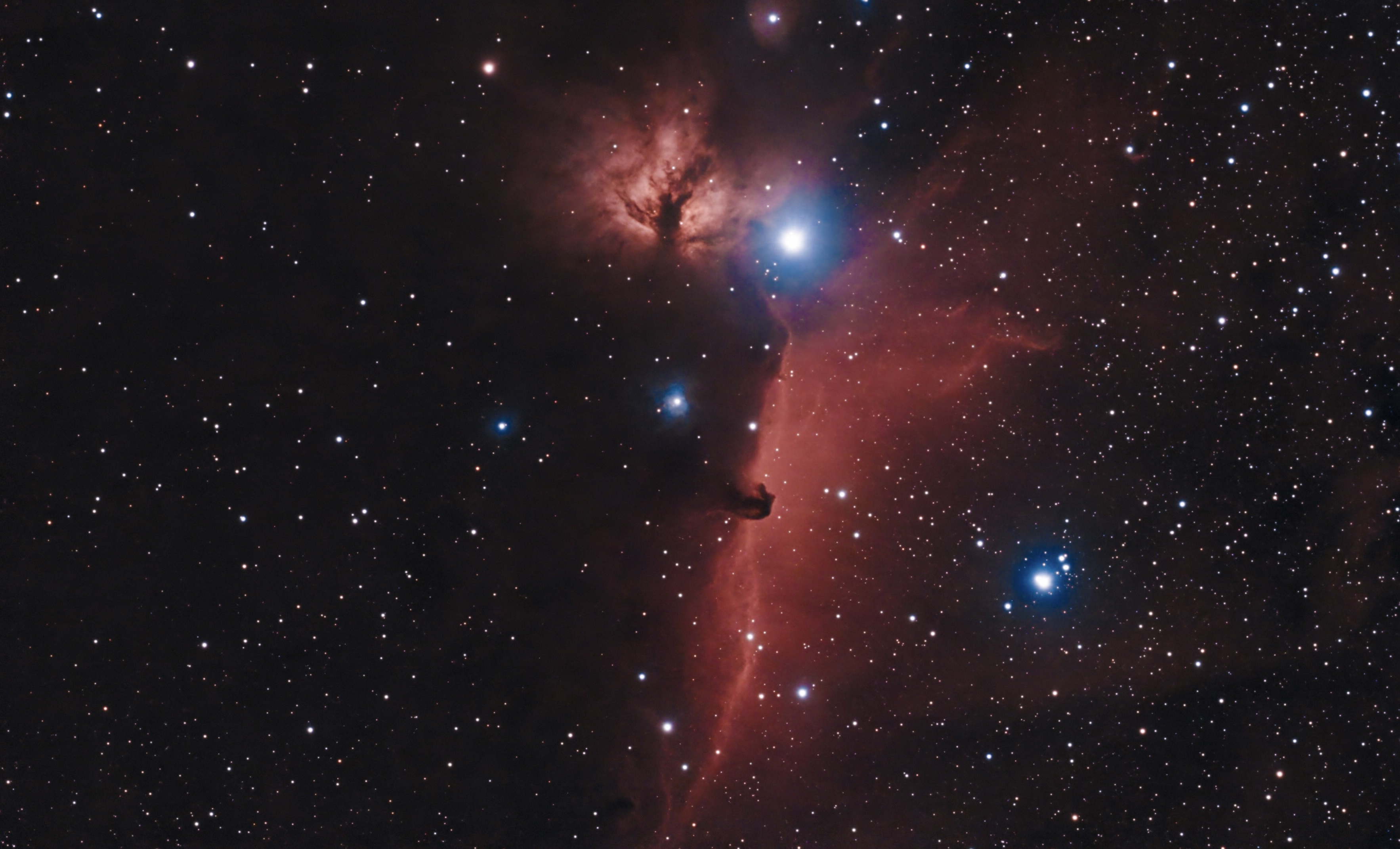
The Horsehead is not a glowing object. It is a dark cloud that shows up as a gap in the IC 434 hydrogen-alpha emission behind it, which makes this a contrast target rather than a brightness target. The Duo-Band filter is doing the real work by making that H-alpha background bright enough that the dark shape becomes legible. Without it, under Bortle 6, the background washes and the silhouette disappears. Full session report →
White-light Solar · December 3, 2025 · not deep sky

Not deep sky. The DWARF 3 can image the Sun with a solar filter, and the December 3, 2025 session caught a substantial active sunspot region crossing the disk. The target is not at infinity and the physics are entirely different from any of the sessions above, but the instrument is the same and the result is part of the record. Full session report →
M42 Orion Nebula · 2h 39m
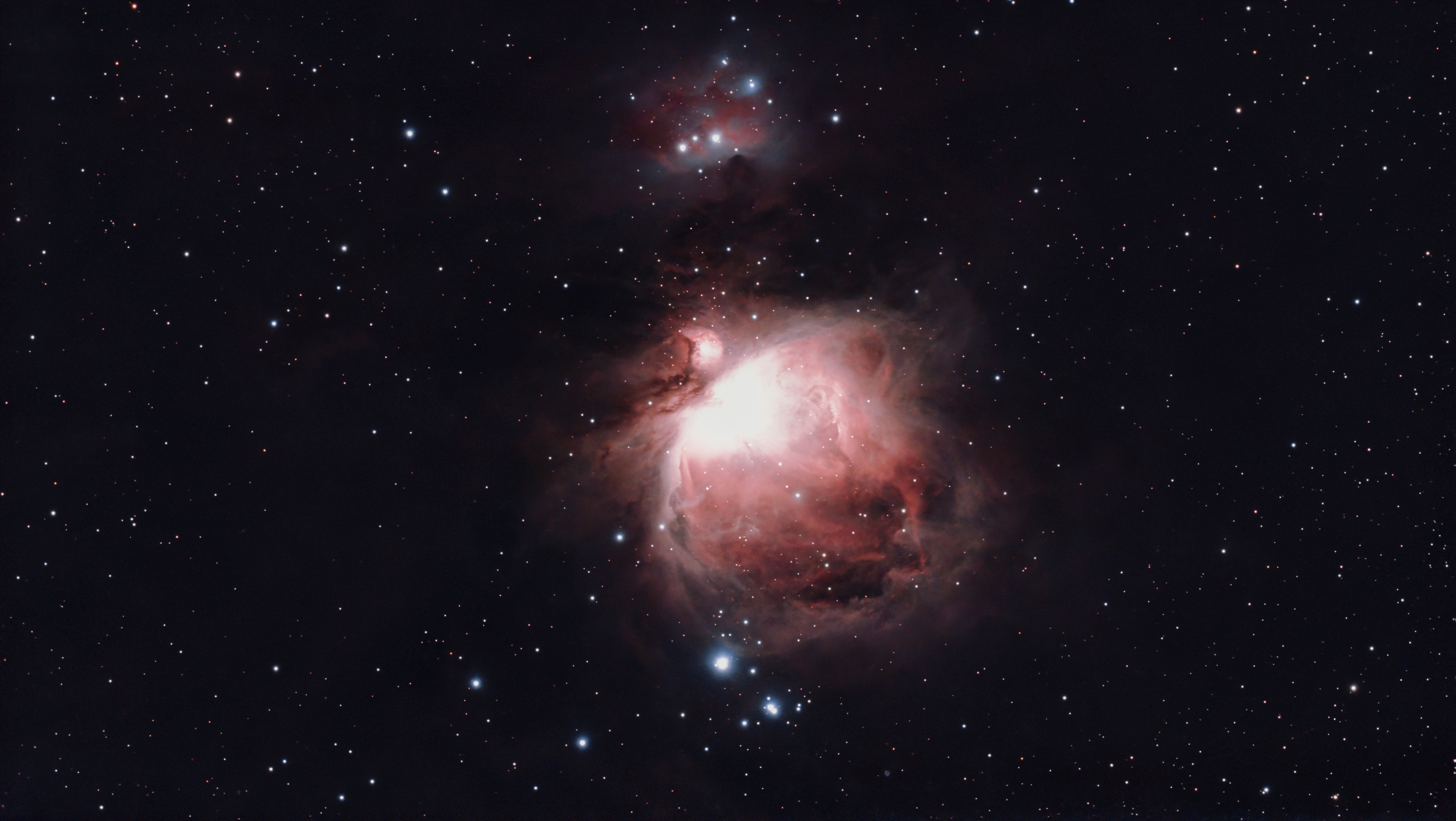
M42 was the first post on this site, which also made it the first time I ran into the dynamic range problem properly. The Orion Nebula core is very bright relative to the outer structure. Stretching the data hard enough to show the faint wisps blows out the center. That is the signal ratio, not a processing error, and there is no clean way around it short of HDR stacking. Full session report →
Rosette Nebula · 2h 21m
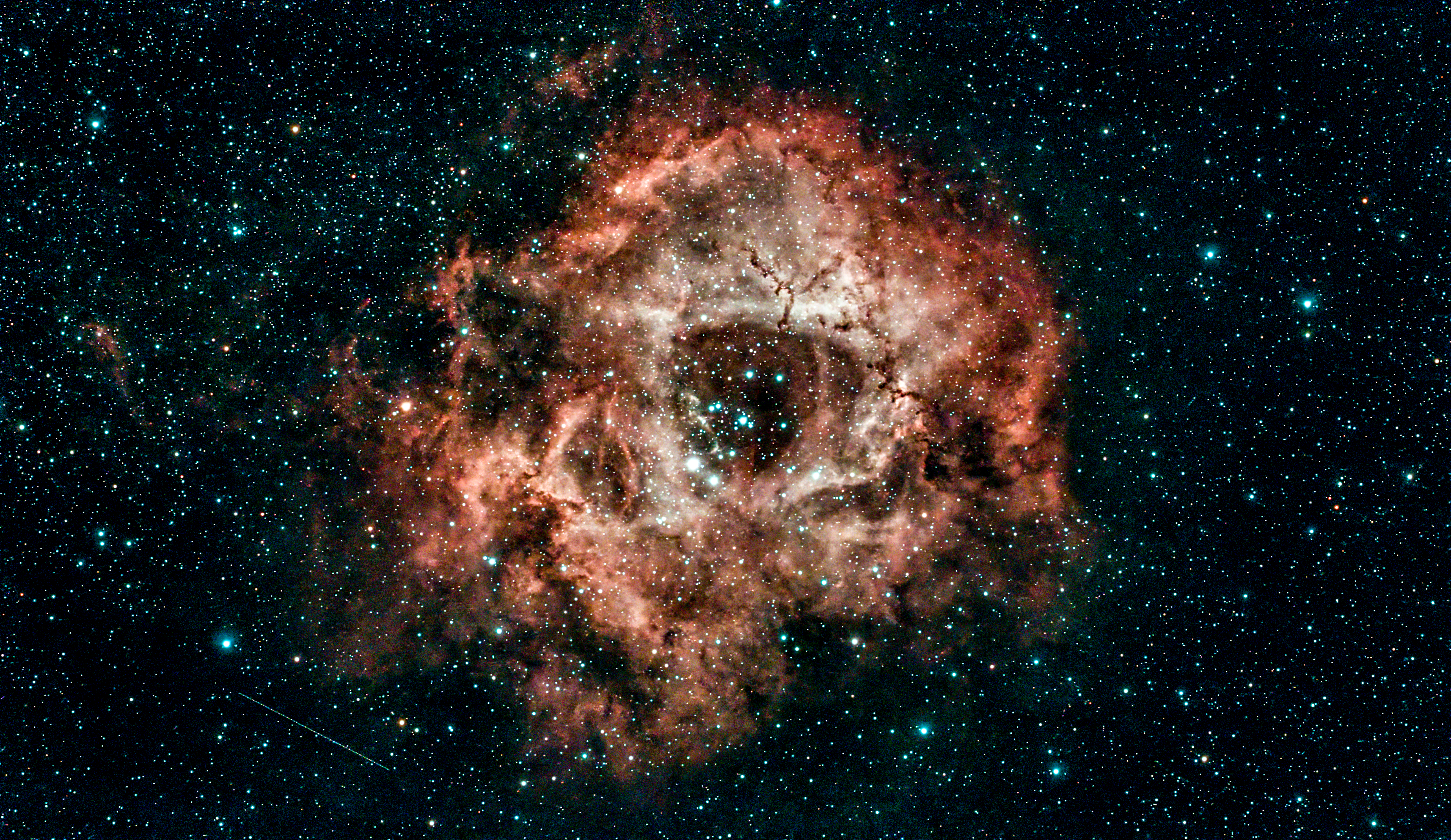
Shot from Monaco, not New England. Heavier light pollution than the backyard, but the Duo-Band filter does not care much about that. The Rosette ring structure came through in 2 hours and 21 minutes. Large target, wide field suits it. Full session report →
M78 Reflection Nebula · ~3h · February 4, 2026

M78 is a reflection nebula, not emission, so instead of glowing from ionized gas it scatters starlight from hot stars embedded inside it. The color is blue for that reason. A faint curve of Barnard’s Loop shows up at the edge of the frame, which was not planned. I submitted this image to a competition and it was not selected. The session post covers what I think would have improved it. Full session report →
Leo Triplet · 4h 38m · February 14, 2026

This stack sat in my archive for almost four months before I wrote it up. M65, M66, and NGC 3628 all fit inside the DWARF 3 telephoto field at once, 35 million light-years out in Leo. The NGC 3628 dust lane, the feature I rated most likely to fail from a suburban sky, came through end to end at 278 subs and 4h 38m. A fourth, unidentified edge-on galaxy sits in the lower right of the frame, not yet plate-solved. Full session report →
M81 and M82 · 15h 14m

15 hours and 14 minutes across multiple nights, with the moon near full for part of it. The stacked result showed UGC 5210 in the field, a background galaxy at approximately magnitude 14.88. That was not something I went looking for. It showed up because there was enough data to pull it out. Full session report →
Pleiades M45 · 30m · March 31, 2026

A 30-minute test session before a longer run on M106. Not expecting a keeper, I got a useful processing comparison instead: the gray background cast that short integrations leave behind, and the Snapseed sequence that cleans it up after Stellar Studio. Shortest deep-sky session on this site by a wide margin. Full session report →
M106 Seyfert Galaxy · 15h 31m

A Seyfert galaxy at 23.7 million light-years. The field also turned out to contain NGC 4226 at approximately 388 million light-years, a radio galaxy that was not guaranteed to show at all through a 35mm aperture with 15 hours of data. NGC 4226 and NGC 4217 sit close in the frame but are not physically related, just a line-of-sight coincidence at very different distances. Full session report →
M101 Pinwheel Galaxy · 6h 18m

Face-on spiral at 21 million light-years. Six hours shows the arm structure clearly enough. The outer HII regions are faintly there but 6 hours is also where you start to see what more time would add rather than feeling like the session is finished. Full session report →
M63 Sunflower Galaxy · 4h 50m

Flocculent spiral at 37 million light-years, which means the arm structure is patchy and irregular rather than the clean sweep of M81 or M101. Four hours and 50 minutes at gain 50 resolved the outer disk well. This was also one of the first sessions where the dark frame library was deep enough to make a visible difference in the background flatness. Full session report →
Star Trail Mode · 720 frames · 6 hours · not deep sky

Not a deep-sky session. DwarfLab added a Star Trail Mode to the app and this was the first test of it: 720 frames at 30 seconds each, wide-angle lens pointed north, stacked in real time. At 6 hours each star traces exactly 90 degrees of arc. The post covers the geometry, why the trail colors are real rather than a processing choice, and what the two diagonal streaks crossing the frame are. Full session report →
M13 Hercules Cluster · 9h 37m · May 30, 2026

561 frames stacked, and the result came back with dark horizontal bands cutting across the cluster. Not a satellite trail, not a hardware fault. One dark calibration frame had picked up stray light, likely from a passing car, and that contamination got subtracted into every one of the 561 stacks. DwarfLab support found the bad file. Pulling it and re-running the stack produced a clean 9h 37m result across two nights, cluster resolved edge to core. The case study on dark frame inspection is in the full post. Full session report →
M51 Whirlpool Galaxy · 8h 14m · Three Sessions
A mega-stack built across three separate nights, months apart: an 8-minute, 30-second first attempt in Alt-Az mode in August 2025, a 6h 32m EQ mode run in April, and a final 1h 40m added in June with particularly clean sensor temperature and matched darks. 8h 14m combined. That depth is what pulled the tidal bridge to NGC 5195 out of the noise, the arm connecting the two galaxies that resulted from a close pass somewhere between 50 and 100 million years ago. A before/after comparison slider between the first 8-minute capture and this final stack is planned for the session post. Full session report →
Whale Galaxy NGC 4631 · 4h 19m · June 2026

A backup target picked while waiting on better conditions for the Squid Nebula. 259 subs, 4h 19m, and the wide field took in the whole group at once: the edge-on Whale, its faint dwarf elliptical companion NGC 4627 (the Pup), and the bent Hockey Stick galaxy NGC 4656 in the lower corner. The bend in the Hockey Stick is a tidal scar, not a stacking artifact. Full session report →
Squid Nebula OU4 / Flying Bat SH2-129 · 17h 33m · June 2026

The longest integration on this site, and the one with the most disappointing answer. Seventeen hours and thirty-three minutes of Duo-Band data on the Squid Nebula inside the Flying Bat, and the OIII signal where OU4 should be measured at roughly 0.2 sigma above the sky noise; the threshold for a confident detection is 5 sigma. Two spots that looked like candidate cores turned out to be star-removal residuals sitting exactly on stars. The teal smudge that looked like nebula was smoothed noise. A 35mm aperture with a Duo-Band filter is not the instrument for this target at any reasonable integration time. Full session report →
Needle Galaxy NGC 4565 · 1h 14m · June 2026

A quick check run before committing real time to the Squid Nebula hunt, and it overdelivered for the time spent. 74 subs, 1h 14m, and the dust lane that splits NGC 4565’s bulge resolved on its own with no real coaxing needed. The faint companion NGC 4562 also showed up to the south. Shortest galaxy session on this site, and one of the cleanest results per hour invested. Full session report →
Fireworks Galaxy NGC 6946 · 4h 8m · July 3, 2026

NGC 6946 has produced ten observed supernovae since 1917, which is how it earned the name. Shot on the night of July 3rd, 248 frames stacked out of roughly 260 captured, 60s subs, gain 50. The Moon rose partway through and stayed in, which flattened the result against what 4 hours 8 minutes of clean data normally delivers. Foreground dust from the Milky Way also dims this galaxy by roughly a full magnitude from its catalog brightness. Worth a return session without the moon. A NexStar 8SE / iPhone 17 Pro moon session also happened around this period — a different telescope entirely, included here as a side note. Full session report →
Shooting Sunspots · July 2026 · not deep sky

Not deep sky. Three solar sessions across five days in late June and early July, tracking a sunspot group across the solar disk. Same telescope, completely different physics: the signal is overwhelmingly bright rather than overwhelmingly faint, and the challenge is resolution rather than depth. Full session report →
Eagle Nebula M16 · 1h 58m · July 11–12, 2026

A 12-minute Alt-Az comparison from August 2025 had appeared in an earlier post as a demonstration of short-exposure limitations. This session supersedes that data entirely. EQ mode, Duo-Band filter, gain 90, 1h 58m, stack completed at 2:33 AM on July 12. The Pillars of Creation resolved as actual structure rather than a soft darkening. This session also went through Siril for stacking and Affinity Photo for finishing alongside the standard Stellar Studio and Snapseed path. Full session report →
Rho Ophiuchi / Antares · 1h 18m · July–August 2026

A two-panel mosaic of one of the lowest-altitude targets on this site: Antares, the globular cluster M4, and the reflection nebula IC 4605, topping out around 20 degrees above the southern horizon. 30s subs, gain 60, Astro filter (broadband is correct here because Antares and its surrounding dust scatter light rather than emit it). Two sessions, July 13 and August 6. The second session lost most of its frames to clouds, which left a visible seam between panels. This one goes back on the list next season. Full session report →
Trifid Nebula M20 · 1h 55m · July 16, 2026

A southern target sitting barely 20 to 25 degrees above the horizon from New England, shot July 16 as what started as a test run. M20 splits into three distinct lobes separated by dark dust lanes in the red H-alpha region. Low altitude means more atmosphere to push through and a shorter window, but the session came back with enough structure showing to count as a keeper. Full session report →
Milky Way · 4h 18m · July 2026

The one target that is not somewhere else in the universe. The DWARF 3’s wide-angle lens covers roughly 45 by 26 degrees, framed across Cygnus on Sadr at the center of the Northern Cross. 516 subs at 30 seconds, gain 60, Astro filter, EQ mode. Four hours and 18 minutes of stacked light pulled the Cygnus star cloud and dark rift structure out of a Bortle 6 sky where the band is nearly invisible to the eye. The wide-angle lens needs its own dark frame set; everything else follows the standard session recipe. Full session report →
Crescent Nebula NGC 6888 · 13h 12m · July 2026

NGC 6888 in Cygnus is a Wolf-Rayet shell: the central star WR 136 is driving a fast stellar wind at roughly 1,700 km/s into the slower shell it expelled 120,000 to 240,000 years ago as a red supergiant. The collision front glows and traces the crescent shape. 792 subs at 60 seconds, gain 90, Duo-Band, EQ mode. The fine filamentary detail along the inner collision front resolved in the second half of the stack, not the first. Full session report →
Elephant’s Trunk Nebula IC1396 · 5h 1m · July 2026

A dark globule inside the larger IC 1396 emission nebula in Cepheus, about 2,400 light-years out. The trunk shape is dense enough to shield its own interior from the ultraviolet radiation of nearby star system HD 206267, which lights the exposed rim while the interior stays dark. Star formation is actively happening inside it. 301 subs, Duo-Band, EQ mode, gain 90, 5h 1m. The wider IC 1396 complex fills the full frame; the trunk is just the one piece dense enough to have its own catalog entry. Full session report →
East and West Veil Nebula · 9h 3m · July–August 2026

Two separate frames of the Cygnus Loop supernova remnant, shot nine nights apart: Eastern Veil (NGC 6992) at 4h 33m, and the Western Veil (NGC 6960, the Witch’s Broom) at 4h 30m. Both in Duo-Band, EQ mode, gain 90. The Cygnus Loop is the remnant of a supernova roughly 20,000 years ago, and the two arcs are separate bright sections of the same expanding shell. The East Veil’s braided filament structure resolved sharply at this integration. The West Veil is fainter and more diffuse and would benefit from more time. Full session report →
Iris Nebula NGC 7023 · 6h 1m · August 9, 2026

A reflection nebula in Cepheus, which means the Duo-Band filter is the wrong tool. The Iris scatters broadband starlight off dust rather than emitting at H-alpha or OIII, so the Astro filter was the correct choice: it accepts more sky glow in exchange for passing the full spectrum the nebula actually produces. 6h 1m on the night of August 9, gain 90. The blue core resolved clearly. The outer dust halo is still emerging and will need more integration to fully separate from the background. Full session report →
Clamshell Nebula Sh2-119 · 6h · August 2026

A large, faint emission nebula in Cygnus, roughly 2 degrees across. Not a common first-timer target, and six hours on it made clear why: signal spread thin across a wide field, with the eastern and western lobes separating from the background only gradually. Duo-Band, EQ mode. This one is not finished and will need more integration time to reach its full depth. Full session report →
What the Data Shows
157 hours and 23 minutes across 27 deep-sky targets, split roughly between galaxies in the first half of the year and emission nebulae in the second. The shift to Cygnus and the summer sky from July onward brought the Crescent, Veil, Clamshell, Eagle, and Iris sessions. These are targets where the Duo-Band filter’s H-alpha and OIII isolation either earned its keep or, in the case of the Iris, turned out to be the wrong tool entirely.
The Squid Nebula result still stands as the clearest example of the aperture limit. At 17h 33m it is the longest single-target run on this site and produced no statistically significant OIII detection. That result sits next to M106 at 15h 31m and M81/M82 at 15h 14m, both of which resolved companion galaxies tens to hundreds of millions of light-years behind the main target. Same instrument, same backyard sky. The difference is what the target emits and what a 35mm aperture with a given filter can realistically pull out of it.
The dark frame library took several months to build into something reliable. Early sessions processed without temperature-matched darks show visibly noisier backgrounds if you look. One bad dark frame nearly cost the M13 session entirely. Checking individual dark frames before using them is now a standing step. The library itself is the reason most sessions this year ran cleaner than sessions at the same integration time from six months earlier.
Processing has also expanded. Most sessions on this site use the Stellar Studio auto-adjust and Snapseed workflow. The Eagle Nebula M16 session added Siril for stacking and Affinity Photo for finishing as a parallel path, and that pipeline is now part of the rotation for Duo-Band emission sessions going forward. The output quality is comparable; the extra steps give more control over the stretch and the fine structure in faint targets.
The hardware did not change across any of this. Same telescope, same sky, same aperture and field of view from the first session to the last. The next twelve months will include reshoot sessions on several of these targets with what I know now, and new targets that were not in reach when this started.
Clear Skies!
What filter works best for emission nebulae with the DWARF 3?
The Duo-Band filter is the consistent choice under light-polluted skies. It isolates H-alpha at 656.3nm and OIII at 500.7nm. Most emission nebula sessions here used gain 90, 60s subs, EQ mode with that filter. Reflection nebulae like M78 and the Iris Nebula require the Astro filter instead, since they produce broadband scattered light rather than narrow emission lines. The Squid Nebula session shows the Duo-Band filter’s limit: at 17h 33m, the OIII signal from OU4 stayed at the noise floor.
How much integration do galaxies need on the DWARF 3?
Results vary widely by target brightness and structure. The Needle Galaxy resolved its dust lane in 1h 14m. The Whale Galaxy group came through in 4h 19m. M51’s tidal bridge needed 8h 14m across three nights to clear the noise. M81 and M106 both needed 15-plus hours to pull out background companion galaxies. 4 to 6 hours produces solid results on most galaxy targets but leaves outer structure underexposed.
Does EQ mode make a meaningful difference over Alt-Az?
Yes. Alt-Az caps subs at around 15 seconds before field rotation causes trailing. EQ mode allows 60s subs. A 60s sub collects four times the signal of a 15s sub at the same gain. The Eagle Nebula M16 comparison on this site shows the difference directly: a 12-minute Alt-Az session from 2025 versus a 1h 58m EQ session from 2026 on the same target.
Can the DWARF 3 detect faint background objects from Bortle 6?
Yes, for galaxies imaged through the Astro filter at enough integration time. The M81 session captured UGC 5210 at magnitude 14.88. The M106 session showed NGC 4226 at approximately 388 million light-years in the same field. The Leo Triplet session turned up a fourth, unidentified edge-on galaxy still waiting on a plate solve. The Squid Nebula session is the counterexample: 17h 33m of Duo-Band data on a faint OIII target produced no detection at all.
Do dark frames make a visible difference on DWARF 3 images?
They do, and a bad one can ruin a session outright. The M13 Hercules Cluster session showed dark banding across all 561 stacked frames because one contaminated dark frame was subtracted into every stack. Removing that single file and restacking produced a clean 9h 37m result. The dark library generally built gradually across these sessions, and early posts without temperature-matched darks show visibly noisier backgrounds.
What settings does the DWARF 3 use for broadband targets?
Most galaxy and broadband nebula sessions on this site use 60s subs at gain 50 with the Astro filter in EQ mode. Emission nebulae use 60s subs at gain 90 with the Duo-Band filter. Wide-field Milky Way sessions use 30s subs at gain 60 with the Astro filter through the wide-angle lens. Dark frames from a temperature-matched library are applied to every session.
What processing tools are used on these images?
Most sessions use Stellar Studio’s auto-adjust for an initial stretch, then export to Snapseed for final edits. Starting with the Eagle Nebula M16 session, Siril for stacking combined with Affinity Photo for finishing is also part of the rotation for Duo-Band emission targets. Pixelmator Pro is being tested as an additional option. The Snapseed workflow remains the fastest path from stack to final image.
Leave a Reply